Chairman of the Sharkovshchina District Executive Committee
- 211921, Sharkovshchina, st. Komsomolskaya, 15
- 8 (021) 546-13-48
- rik@sharkovshchina.vitebsk-region.gov.by
- пн
- вт
- ср
- чт
- пт
- сб
- вс
Acceptance of applications from citizens and legal entities from 8.00

Executive Committee
Sharkovshchina Regional
Executive Committee
16 April 2025
Belarus opts to develop ultra-modern pig farming
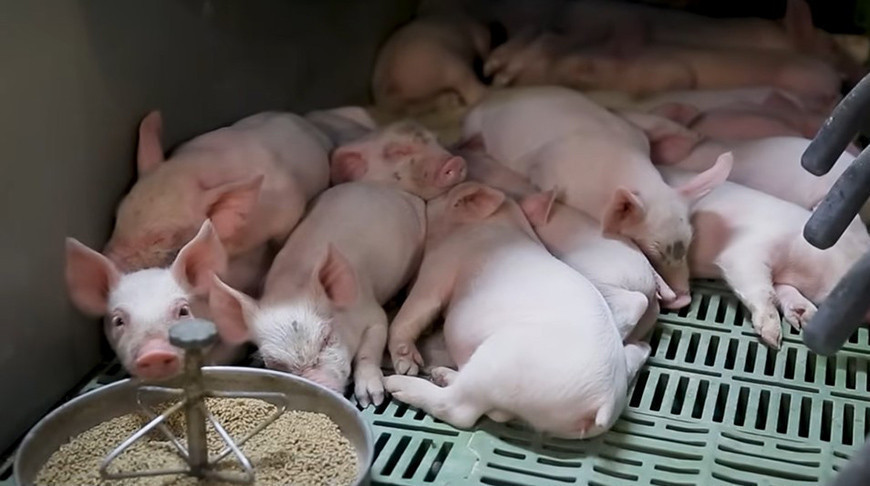
For Belarus, the development of the pig industry is of particular importance. In all regions there are large pig breeding complexes that supply pork domestically and internationally.
However, the outbreak of African swine fever in 2013 put the industry at risk. Other problems accumulated over time too. The pig industry in Belarus was still in a difficult situation. Aleksandr Lukashenko had to take this issue under his personal control, and only thanks to timely measures, the situation was gradually stabilized. Now farmers are optimistic about the future. In a new episode of BelTA’s YouTube project “After the Fact: Lukashenko’s Decisions” we will tell you what the current situation at pig farms in Belarus is. Why do pig farm
How much pork does Belarus produce?
Every year Belarusians consume about 295,000 tonnes of pork, and local enterprises satisfy the domestic demand fully. The bulk of meat is produced at industrial pig complexes. There are a little more than 90 of them in Belarus. On average, each of them can accommodate about 20,000-25,000 head. These are quite compact farms, but they have proved themselves to be the best option in our country.
However, Aleksandr Lukashenko is convinced that the Belarusian pig industry has much better prospects. In order to improve its performance, the president suggested modernizing pig complexes, observing elementary technological and labor discipline, intensifying breeding and pedigree work and improving mixed fodder recipes. The president called biological protection of pig farms a task of national importance.
“There must be a specific program to bring these complexes back into shape. Otherwise, we will not be able to produce even a kilogram of pork and to have a shashlyk picnic in the countryside. Farms are worn out, obsolete morally and physically. Let's think about a centralized program of reconstruction of our pig breeding complexes and construction of new ones,” Aleksandr Lukashenko said at a meeting to discuss pig industry development in September 2023.
Some six months later the head of state repeatedly urged farmers to work for the future and instructed to develop a 10-year program for the development of ultra-modern pig farming in Belarus. “It should embrace everything: progressive genetics, fodder, eco- friendliness. The goals are very ambitious: maximum processing and export expansion,” the president noted.
Such a strategy for the development of ultra-modern pig farming in Belarus was approved. Its priorities include the construction of new pig farms, improvement of breeding and pedigree work, development of feeding rations for pigs taking into account their breed and productivity, introduction of digital surveillance system in production facilities, creation of large agricultural holding companies, which will include land, feed mills, meat processing, trade organizations.
“Last year, Belarus produced more than 413,000 tonnes of pork. We fully meet the domestic demand for this product. Nevertheless, a new task has been set. We have developed a strategy to switch to ultra-modern pig farming by 2034. To this end, we plan to build about 12 new modern pig farms; four of them are designed for over 100,000 head. If everything goes as planned, we will be able increase pork production by 80,000 tonnes. Thus, the total pork output will be about 500,000 tonnes,” said Natalya Sonich, Head of the Directorate for Intensification of Livestock and Fish Production at the Agriculture and Food Ministry.
What is ultra-modern pig farming?
But what does ‘ultra-modern pig farming’ mean and what kind of digital surveillance systems will be installed at pig farms? For example, now in order to track the weight of an animal, it must be taken to the scales. This causes a certain stress for piglets. Therefore, in the coming years, digital devices will be installed in piggeries to scan the animals and identify the smallest deviations from the weight norm. But, as practice shows, it is one thing to have technology, and another to know how to use it. And the president has also raised this question.
“Of course, we will provide support and assistance. But we are not going to waste money. And we don’t want to have anything to do with those who do not want to work. Not because I am mean, but because there is no other way: we must preserve the country. I am still surprised that we can sit and talk about pig farming today when the situation around us is so turbulent. We talk about shashlyk picnics, other things. People in other countries have other concerns than that, even in rich countries,” Aleksandr Lukashenko said at the national seminar on livestock farming in 2023.
“Therefore, you should keep in mind that we don’t have money to waste. Every penny should be accounted for. I am not saying that we will scale something down. We are thrifty people. I do not demand the impossible from you in agriculture. You just need to eliminate the existing bottlenecks. Solve the problems that are on the surface. This will be good enough for people of our generation,” the head of state said.
Biological safety at pig farms
In order to protect animals from diseases and stress and to increase pork output, enterprises need to keep up with new production trends and constantly improve. This is what they do at the Bolshevik-Agro farm. In 2016, a pig-breeding complex with a designed capacity of 24,000 head per year and a feed mill were built at the enterprise using Israeli technology.
“First of all, ultra-modern pig farming is all about production technology. This includes the development of innovative farm-specific pig-breeding techniques, treatment and vaccination protocols and, of course, pig-keeping technologies. This includes the microclimate, the watering system, and breeding. Today we use three main European breeds - Yorkshire, Duroc and Landrace. And the complex has practically switched to the so-called F2 selection (reverse crossbreeding). It means that it combines the best properties of each breed: average daily weight gain, survival rate and birth rate. As a result, the product quality is several times better than if we used purebred livestock,” Director of Bolshevik-Agro Oleg Upenik said.
s use “milk taxi” and why do pigsties smell... vanilla? What is the strategy for the development of ultra-modern pig breeding? Do the Belarusians really risk losing the opportunity to have shashlyk picnics? To find answers to these questions, we visited one of pig farms. It turned out to be more difficult to get there than to a nuclear power plant. Now we will tell you all about it.